Sunday, 12 January 2014

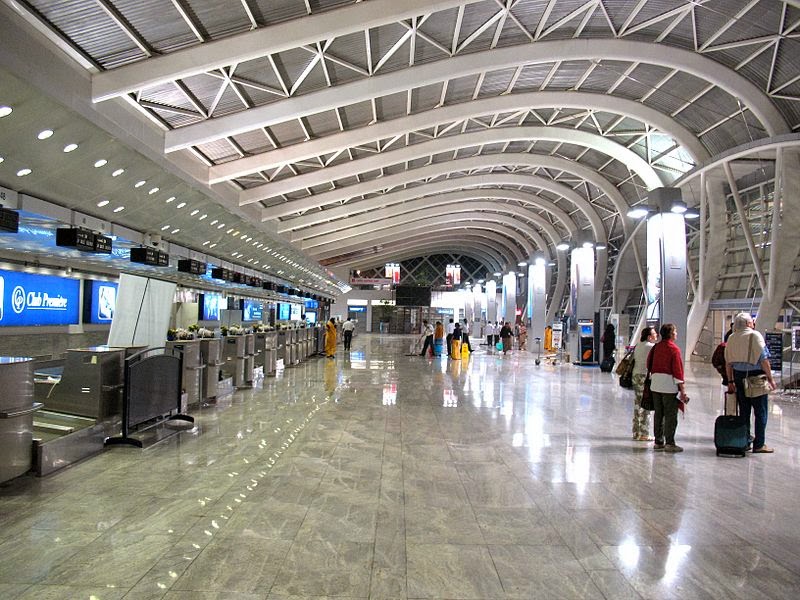
Chhatrapati Shivaji International Airport, Terminal 2.....Swankyyy, isn't it!!!


A swanky Terminal 2 / T2 at Chhatrapati Shivaji International Airport (CSIA) 

.
India's overcrowded financial capital(Mumbai) unveiled its long-awaited Rs 5,500 crore new airport terminal on Friday, an ambitious, art-filled space that developers hope will be a showcase success in a country struggling to modernize inadequate infrastructure that is holding back economic growth.
The state-of-the-art Terminal 2 or T2 at Chhatrapati Shivaji International Airport (CSIA) was officially inaugurated by Prime Minister Manmohan Singh on Friday. Built at cost of over Rs5,500 crore, the terminal will be thrown open to public within four weeks.
“Mumbai deserves a world-class facility like the T2,” Singh said, adding that “opening of T2 will inspire other infrastructure projects to achieve similar feat.”


According to aviation experts, development of the airport seems significant for the city as unlike other important airports, CSIA is located in a confined area with no space to expand. Only 1,400 acres are available. On the contrary, Hyderabad and Bengaluru airports have over 5,500 acres of land available and the development had to be carried out without disrupting the on-going flight operations.
In January 2006, GVK led consortium, comprising of Airports Company South Africa and Bidvest won the bid to manage and operate GVK CSIA. To accomplish this task, Mumbai International Airport Pvt. Ltd. (GVK CSIA) was formed by GVK led consortium (74%) and Airports Authority of India (26%)..
In 2012-13, the airport handled 30.21 million passengers and 0.6 million tonnes of cargo. According to forecast by aviation experts, the passenger traffic in Mumbai is expected to reach 80 million per annum by 2026. Likewise, the air cargo is expected to reach 2 million tonnes. With the opening of T2, the passenger capacity of CSIA will shoot up more than 40 million passengers annually. Under the privatisation policy of the central government, CSIA was given to private parties for modernisation in 2006. GVK-led consortium bagged the contract for Mumbai airport.
The spanking four-storey glass marvel, whose design has been inspired by a dancing peacock, has some of the most advanced state-of-the-art passenger convenience system. It has 208 check-in-counters, 43 security pedestals, 161 elevators, one day hotel and one transit hotel, automated baggage system capable of handling 9,600 bags per hour, and a dedicated 6-lane elevated expressway.
The terminal also has country’s largest multi-level car parking area as well as world’s longest cable stayed glass wall (15 metres).

Partially Frozen Niagara Falls


Niagara Falls frozen partially on Tuesday, 07 Jan 2014.The ice formed on the U.S. side of the falls  straddle the border between the United States and Canada. The frigid air and "polar vortex" affected about 240 million people in the United States and southern Canada.
A blast of Arctic air gripped the mid-section of the United States on Monday, 06 Jan 2014, bringing the coldest temperatures in two decades. Meteorologists said temperatures were dangerously cold and life-threatening in some places, with 0 degrees Fahrenheit (minus 18 Celsius) recorded in Chicago, St. Louis and Indianapolis. The icy images taken may look spectacular, but it also warns of unwarranted weather foes that are going to increase in the near future because of global warming.

Ice chunks and water flow over the falls Niagara Falls, Ontario, January 8, 2014

Ice flows on the Canadian and US water falls at Niagara Falls, in the State of New York, USA, on January 9, 2014

The U.S. side of the Niagara Falls is pictured in Ontario, January 8, 2014

Ice flows on the Canadian and US water falls at Niagara Falls, in the State of New York, USA, on January 9, 2014

Ice flows on the Canadian and US water falls at Niagara Falls, in the State of New York, USA, on January 9, 2014

Ice flows on the Canadian and US water falls at Niagara Falls, in the State of New York, USA, on January 9, 2014

The U.S. side of the Niagara Falls is pictured in Ontario, January 8, 2014

Ice flows on the Canadian and US water falls at Niagara Falls, in the State of New York, USA, on January 9, 2014

The Rainbow Bridge shown in Niagara Falls, Ontario, January 8, 2014

Niagara Falls, Ontario, January 8, 2014

Niagara Falls, Ontario, January 8, 2014

Niagara Falls, Ontario, January 8, 2014

Niagara Falls, Ontario, January 8, 2014

Niagara Falls, Ontario, January 8, 2014

Niagara Falls, Ontario, January 8, 2014

                    The U.S. side of the Niagara Falls is pictured in Ontario, January 8, 2014

Ice forms on the shore of the East River due to unusually low temperatures caused by a Polar Vortex in New York January 7, 2014

Ice forms on an abandoned dock structure in the East River due to unusually low temperatures caused by a Polar Vortex in New York January 7, 2014

A blanket of fog covers Lake Michigan along the Chicago shoreline Monday, Jan. 6, 201

a bus shelter in downtown Chicago, Illinois January 6, 2014

a frozen wall on a beach in Chicago, Illinois, January 7, 2014

Chicago, Illinois, January 6, 2014

a beach in Chicago, Illinois, January 7, 2014

St Louis_Sunday, Jan. 5, 2014

St Louis_Sunday, Jan. 5, 2014

St. Louis_Sunday, Jan. 5, 2014

The Chicago skyline is seen beyond the arctic sea smoke rising off Lake Michigan in Chicago, Illinois, January 6, 2014

Zionsville, Ind - Sunday, Jan. 5, 2014

St Louis_Sunday, Jan. 5, 2014


Photos by: REUTERS/Aaron Harris/Jim Young/AP Photo/Jeff Roberson/Michael Conroy/Teresa Crawford/Darron Cummings/Nam Y. Huh/Brian Peterson/Kiichiro Sato/Charles Rex/Michael Dwyer/Kiichiro Sato

Saturday, 11 January 2014

How to file income tax returns online in India


 Compulsory E-filing All individuals  who have taxable income of above Rs 5 lakh in the financial year 2012-13, are mandatorily required to file their income tax return  online (e-filing) in the assessment year (AY) 2013-14.  Last year, the limit was Rs 10 lakh. So, ensure you abide by the new rule.
The government of India has made many amendments to the Income Tax Act 1961, in the Budget 2013-14. While filing the return, you have to keep in mind the changes. Then, you have to understand the form that you have to fill. The salaried individuals, who are required to file their returns latest by July 31.
However, the process is not as cumbersome as it is assumed to be. If you are a salaried individual not liable to pay any additional taxes and are not expecting any refund from the income tax department, you can follow following simple steps to complete the process within an hour,

8 Steps to file your IT -Returns


Step 1: Log on to www.incometaxindia.gov.in  (or directly log intowww.incometaxindiaefiling.gov.in )and register yourself, if you haven’t done so already. Your PAN will act as your user ID.
Filing returns through this IT department official website is free.
Step 2: The next step is to download the ITR form applicable to you. You will find the forms in ‘Downloads’ menu. This year, most tax-payers will have to download Form ITR 2 as those with tax-exempt income of over Rs 5,000 cannot file their tax return using Form Sahaj (ITR 1). In simple terms, if your salary includes components like conveyance allowancehouse rent allowance (HRA), leave travel allowance, etc, which collectively exceed Rs 5,000 in a year, you will have to opt for ITR-2.  See at the end of this page for more information on which form you should select
Step 3: Once you download the Return Form’s excel utility, you need to enter all the details asked for by referring to the Form 16 issued by your employer.
Form 16 should be sufficient enough to provide all the details, if you don’t have any other source of income apart from salary.
Step 4: Now, validate the information by clicking the ‘Validate’ key. An XML sheet will be generated and saved on your computer.
Step 5: Upload the XML file on to the I-T e-filing website after selecting AY 2013-2014 and the applicable ITR form. You will be asked whether you wish to digitally sign the file. If you have obtained the DS (digital signature), select ‘Yes’. Otherwise, choose ‘No’ and proceed further.
Step 6: If the process is completed as per the requirements, the site will flash a message indicating the success of your e-filing process. You can check your mailbox to ascertain whether your ITR-Verification form has been mailed to your registered e-mail ID.
Always provide your personal mail ID, but not you office mail ID. Refer bottom of this page for more info.
Step 7: Next, get a print-out of your ITR-V, sign the form (in blue ink) and send it by ordinary post to the Income Tax Department-CPC, Post Bag No-1, Electronic City Post Office, Bangalore – 560 100, Karnataka within 120 days of filing your returns electronically.
Step 8: If you do not receive any acknowledgement from the I-T Department, you should send the form again. However, avoid enlisting the services of courier companies, as your form will not be accepted. Forms sent through Speed Post, though, will be accepted.

Choose the right form
ITR-1, known as Sahaj form, has to be filled by individuals who have income from salary or pension, receive income from one house property or have income from sources other than winnings from lottery and race horses.
ITR -2 : If you received more than Rs 5,000 tax-exempt income during 2012-13, you will have to use the ITR 2 for filing your return this year. Exempt income includes tax-free sources of income, such as the interest on PPF, tax-free bonds and dividends.
-> Also, a taxpayer is not supposed to use ITR 1 if he has foreign assets or has claimed tax relief under any double taxation avoidance treaty.
-> Also, if you have a loss brought forward from previous year, you have to file ITR-2.
Remember following points before submitting the ITR-1 or ITR-2 
1. Submit all Form 16: If you have changed jobs, ensure that you collect the Form 16 from the past employer as well. There is a good possibility that your past employer too has deducted tax, which means you could have paid extra tax. Hence you might just be eligible for a refund if you submit all the relevant Form 16 documents.
2.  Be careful with email address: Never use your office email address on the ITR form. If you change jobs in the future, you won’t have access to that email address. Giving your office email ID on ITR form is one of the dumbest mistakes you could ever make.
3. Submit all information regarding income from other sources information: It becomes imperative that you declare all the income you earn even from other sources like capital gains even if such income is not taxable. Also mention income from other sources, right from sale of house property as well as rental income. 4. If you have more than one house and the other house is lying vacant, don’t forget to add the notional rent of the vacant house in the total taxable income.
4.  Sending e-filing acknowledgement on time: Once you file the returns, you get an ITR -V acknowledge, which you need to submit to the IT department’s Bangalore office within 120 days. First mistake many make is that they forget to send the ITR V acknowledgement within the deadline. Another thing you need to keep in mind that you need to send it via post or speed post and not courier. And thirdly, you need to sign the acknowledge in blue ink and not black.
5.  Double check numbers: If your agent is filing the form for you, ensure you check it before submitting. Even spelling mistake could cost you later. Next is to ensure there are no typos, especially in the PAN, TAN number. There is a good possibility you could be fined for a wrong entry. So double check all numbers once before submitting the form online. Even the IFSC number of your bank, if you are expecting a refund.
6. Income from fixed deposit or savings bank account is taxable.
7.  Any investment in name of your wife, husband, or minor child will be clubbed with your taxable income and will be taxed under section 64 of the income tax act. However, such income is exempt up to Rs 1,500 each for two children.
8. If you have received gift in cash of more than Rs 50,000 from someone who is not your relative or spouse, you have to include that in your total taxable income under section 56 of the Act. Similarly, if you received any immovable property as a gift, the stamp duty value of which exceeds Rs 50,000, you have to include that too.
9. Income from short-term capital gains like sale of shares or an equity-oriented mutual fund should be filled in the form. It is taxable as per section 111A at a flat rate of 10 per cent. However, if it is sale of any other asset it is taxed at the normal slab.
10. Though long-term capital gains are not taxable, they have to be mentioned in ‘other assets’ under section 112(1). This includes consideration received for assets sold such as house property.
11. Winnings from lottery also need to be mentioned in the return.
12. Bank account number and MICR code has to be mentioned in the form. In case you fill either of these wrong, you would need to submit a cancelled cheque showing the corrections. You may also log on to the website and make a refund re-issue request under ‘My Account’.

If still confused,

There are few private websites which helps you file your e-returns. These websites charge individual taxpayers between Rs 200 and Rs 4,000 for uploading their tax returns.  However, private tax filing portals hand-hold the taxpayer through the process. They guide you while filling the form and even correct you if you make a mistake. You can use any of these below web sites for such services.

Income Tax Exemption Limit – 2013-14


I. Individuals (Below 60years)

Up to Rs 2 lakh  :  No tax
From Rs 2 lakh to 5 lakh : 10%
From Rs 5 lakh to 10 lakh : 20%
Above Rs 10 lakh : 30%
Education Cess: 3% of the Income-tax.
(** Tax credit of Rs. 2000/-  if income does not exceed Rs. 5,00,000/-)
Note : There are no more separate income tax slabs for men and women. The slabs mentioned here are equal to both men and women.

II. Senior Citizens ( Above 60 years but below 80 years)
Up to Rs 2.5 lakh : No tax
From Rs 2.5  lakh to 5 lakh : 10%  From Rs 5 lakh to 10 lakh : 20%
Above Rs 10 lakh : 30%
Education Cess: 3% of the Income-tax.
(** Tax credit of Rs. 2000/-  if income does not exceed Rs. 5,00,000/-)
…………….
III.   Very Seniors Citizens ( Above 80 years)
Up to Rs 5 lakh: No tax
From Rs 5 lakh to 10 lakh: 20%
Above Rs 10 lakh: 30%
Education Cess: 3% of the Income-tax.
………..
Income tax Structure 2013-14 (Assessment Year 2013-14) – Budget highlights
-> No revision in Income tax slabs
-> Income Tax Credit of Rs.2000 to Every Person with Total Income up to 5 Lakhs
-> Surcharge of 10% on income more than Rs. 1 crore
-> Home Loan Income tax Exemption limit increased from Rs.1.5 lakhs to Rs.2.5 lakhs for loan up to Rs.25 lakhs


Preamble to the Constitution of India


Preamble to the Constitution of India


“ WE, THE PEOPLE OF INDIA, having solemnly resolved to constitute India into a SOVEREIGN SOCIALIST SECULAR DEMOCRATIC REPUBLIC and to secure to all its citizens:
JUSTICE, social, economic and political;
LIBERTY, of thought, expression, belief, faith and worship;
EQUALITY of status and of opportunity;
and to promote among them all
FRATERNITY assuring the dignity of the individual and the unity and integrity of the Nation;
IN OUR CONSTITUENT ASSEMBLY this twenty-sixth day of November, 1949, DO HEREBY ADOPT, ENACT AND GIVE TO OURSELVES THIS CONSTITUTION.”
————–
NOTE:The original 26 November 1949 constitution stated “SOVEREIGN DEMOCRATIC REPUBLIC” and “unity of the Nation”, the words “SOCIALIST SECULAR” and “Unity and Integrity” were added via the 42nd amendment during the Emergency in 1976).

Meaning


Enacting formula

It signifies the democratic principle that power ultimately rests in the hands of the people. It also emphasizes that the constitution is made by and for the Indian people and is not given to them by any outside power. The wording is close to the preamble to the constitution, which had been adopted in 1937; it reads “We, the people of India … Do hereby adopt, enact, and give to ourselves this Constitution”. All the power emanates from the people and the political system will be accountable and responsible to the people.

Sovereign

The word sovereign means supreme or independence. India is internally and externally sovereign – externally free from the control of any foreign power and internally, it has a free government which is directly elected by the people and makes laws that govern the people. She allies in peace and war. The Popular sovereignty is also one of the basic structures of constitution of India. Hence, Citizens of India also enjoy sovereign power to elect their representatives in elections held for parliament, state legislature and local bodies as well. People have supreme right to make decisions on internal as well as external matters. No external power can dictate the government of India. All the people are free in a limit to do their work in their own opinion.

Socialist

The word socialist was added to the Preamble by the Forty-second Amendment during the Emergency in 1976. It implies social and economic equality.
Social equality in this context means the absence of discrimination on the grounds only of caste, colour, creed, sex, religion, or language. Under social equality, everyone has equal status and opportunities.
Economic equality in this context means that the government will endeavor to make the distribution of wealth more equal and provide a decent standard of living for all. This is in effect emphasized a commitment towards the formation of a welfare state. India has adopted a socialistic and mixed economy and the government has framed many laws to achieve the aim.

Secular

The word secular was added to the Preamble by the Forty-second Amendment during the Emergency in 1976. Citizens have complete freedom to follow any religion, and there is no official religion. The Government treats all religious beliefs and practices with equal respect and honor.

Democratic

The first part of the preamble “We, the people of India” and, its last part “give to ourselves this Constitution” clearly indicate the democratic spirit involved even in the Constitution. India is a democracy. The people of India elect their governments at all levels (Union, State and local) by a system of universal adult franchise; popularly known as “one man one vote”. Every citizen of India, who is 18 years of age and above and not otherwise debarred by law, is entitled to vote. Every citizen enjoys this right without any discrimination on the basis of caste, creed, colour, sex, religion or education.

Republic

As opposed to a monarchy, in which the head of state is appointed on hereditary basis for a lifetime or until he abdicates from the throne, a democratic republic is an entity in which the head of state is elected, directly or indirectly, for a fixed tenure. The President of India is elected by an electoral college for a term of five years. The post of the President Of India is not hereditary. Every single citizen of India is eligible to become the President of the country. The leaders of the state and local bodies are also elected by the people in similar manner.

Forty-second Amendment 

On 18 December 1976, during the Emergency in India, the Indira Gandhi government pushed through several changes in the Forty-second Amendment of the constitution of India. A committee under the chairmanship of Sardar Swarn Singh recommended that this amendment be enacted after being constituted to study the question of amending the constitution in the light of past experience. Through this amendment the words “socialist” and “secular” were added between the words “sovereign” and “democratic” and the phrase “unity of the Nation” was changed to “unity and integrity of the Nation”.